



















It’s a familiar story I’ve heard from countless WooCommerce store owners. You’re up late, looking at the dashboard, and the revenue graph is pointing up and to the right. It should feel great. But then you check your bank account, and that familiar frustration hits you. Sales are climbing, but where is the actual cash profit?
You’re not alone in this struggle. Many successful entrepreneurs master the art of selling only to find themselves trapped in a cycle of high revenue and disappointingly low margins. This isn’t a sales problem; it’s a profitability problem. It’s born from the small, hidden costs, imperfect pricing, and operational leaks that quietly drain your bottom line.
This guide is designed to stop those leaks. I’m not going to give you a gimmicky, trademarked “system.” Instead, I’m going to share a practical approach built on years of experience, designed to transform your business from a revenue-generating machine into a profit-compounding engine. This isn’t about working harder; it’s about making every sale, every click, and every shipment work smarter for you.
First, Find the Hidden Costs Silently Sinking Your Store
Before you can grow your profit, you have to find where it’s disappearing. In e-commerce, several “invisible” costs are often the primary culprits. Getting a firm handle on these is the first step toward taking back control of your profitability.

Think of your revenue as a whole pie. Here’s how it typically gets sliced up before you even get a piece:
- Cost of Goods Sold (COGS) – Roughly 42%: This is the direct cost of the products you sell. It directly reduces your gross profit, which is the money you have left to pay for everything else. Your main leverage here is better product sourcing and supplier negotiation.
- Shipping & Fulfillment – Roughly 15-20%: This erodes your net profit with every single order. If managed poorly, it can make you completely uncompetitive. The key is logistics optimization and negotiating better rates with carriers.
- Marketing & Customer Acquisition (CAC) – Roughly 20-30%: Spending a lot to get a customer who only buys once is a huge profit drain. The goal is to improve conversion rates and focus on customer retention to lower this percentage.
- Payment Processing Fees – Roughly 2-3.5%: While it seems small, this is a constant leak that disproportionately hurts orders with lower values. Strategic selection of your payment gateways can make a real difference.
- Returns & Refunds – Roughly 8-10%: This is a double whammy. You lose the revenue from the sale and have to absorb the costs of return shipping, damaged goods, and the labor to process it all. The fix lies in providing accurate product information and having a smart return policy.
- Platform & Tech Fees – Roughly 3-5%: This is your fixed overhead. It can easily bloat with too many unnecessary plugins and subscriptions. Regularly auditing your tech stack is crucial.
A Practical Approach: Four Areas to Master for Real Profit Growth
Profitability isn’t about finding one magic bullet. It’s about strengthening four interconnected parts of your business. When you make a smart change in one area, you’ll see benefits in the others. This creates a powerful cycle of compounding profit.
- Strategic Pricing: Moving beyond simple markups to price products based on their true value, your position in the market, and customer psychology. This is about capturing the maximum possible profit from every sale.
- Smart Sourcing & Cost Control: Systematically lowering your Cost of Goods Sold (COGS) and other core expenses. This gives you more breathing room and margin to work with on every item you sell.
- Optimized Operations: Turning logistics like shipping, returns, and payments from money pits into strategic advantages that can even improve customer loyalty.
- Data-Driven Decisions: Using your store’s own data to stop guessing. Making informed choices is what separates the businesses that thrive from those that just survive.
1. Strategic Pricing: Your Most Powerful Profit Lever
Pricing is the fastest way to change your profitability. Set it too low, and you’re leaving cash on the table. Set it too high, and you risk scaring away customers. Here’s how to find that sweet spot.
Cost-Plus Pricing: Your Safety Net
This is the absolute baseline: Cost + Desired Profit = Price. It’s straightforward and ensures you never accidentally lose money. While it doesn’t account for market dynamics, it’s the non-negotiable first step. You must know your numbers to ensure you’re covering all associated costs.
Value-Based Pricing: Tying Price to What It’s Worth to the Customer
This is a more advanced strategy where you price your products based on the perceived value they deliver. If your product solves a significant problem or offers a unique benefit that others don’t, you can command a premium price that is much higher than your cost. The extra margin this generates can be reinvested to enhance that value even further, creating a fantastic upward spiral.
Competitive Pricing: Using the Market to Your Advantage
This involves setting your prices in relation to your competitors. But be careful. Simply matching the lowest price is a race to the bottom that nobody wins. The smart way to do this is to use competitor data as a reference point, but always stay anchored to your own cost structure and unique value. Are you offering better service, faster shipping, or higher quality? Price accordingly.
Psychological Pricing: Nudging Customers Toward “Buy”
These are subtle psychological cues that make your prices feel more appealing.
- Charm Pricing: Ending a price in .99 (like $49.99 instead of $50) is a classic for a reason. It can make a price feel significantly lower.
- The Decoy Effect: Introduce a third option that makes your preferred option look like a no-brainer. For example, Small for $15, Large for $25, or a Medium for $22. The Medium makes the Large look like a much better deal.
- Anchoring: Show a higher original price to make the current price seem like a bargain (“Was $150, Now $99”). This frames the purchase as a smart, money-saving decision.

2. Smart Shipping: From a Cost Center to a Profit Booster
Shipping is no longer just a line item expense; it’s a crucial part of the customer experience and a major lever for profitability. Here’s how to turn it from a burden into a strategic asset.
Offer Tiered Shipping, Not Just “Free Shipping”
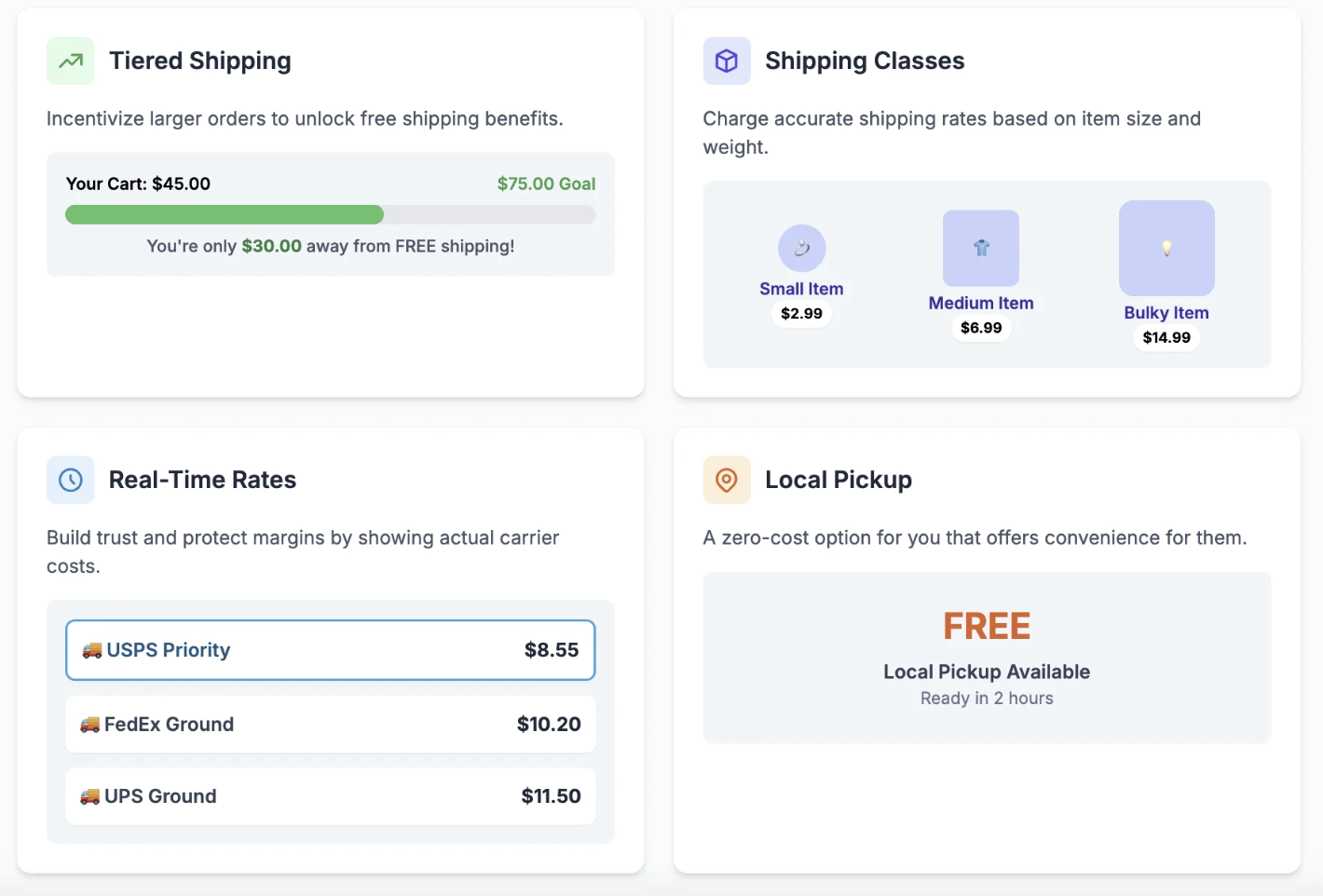
Instead of absorbing 100% of the shipping costs on every order, incentivize customers to spend more. A very effective strategy is: “$5 flat rate shipping on orders under $75, but free shipping on orders over $75.” This tactic directly increases your Average Order Value (AOV), which spreads your fixed costs over more revenue and instantly boosts the margin on every shipment.
Use Shipping Classes in WooCommerce
Go into your WooCommerce settings and group products by size or weight (e.g., “Small Items,” “Bulky Items”). This allows you to set more accurate shipping rates instead of overcharging for a keychain or, even worse, losing a significant amount of money shipping a heavy item.
Display Real-Time Carrier Rates
There are excellent plugins that can pull live rates directly from carriers like USPS, FedEx, and UPS. This builds trust because customers see they are paying the actual cost. More importantly, it ensures you never undercharge and lose profit on shipping.
Never Underestimate Local Pickup
This is a zero-cost shipping option for you and a fantastic convenience for your local customers. It also creates a natural opportunity for in-person upsells when they come to your location.
3. Smart Sourcing: The Direct Path to Lowering Your COGS
Your Cost of Goods Sold (COGS) is almost certainly your single biggest expense. Even shaving a few percentage points off your sourcing costs flows directly to your net profit.
Dropshipping vs. Bulk Buying: A Strategic Decision
- Dropshipping: This method is low-risk and involves no inventory holding costs, making it perfect for testing new products. The trade-off is razor-thin profit margins and very little control over the customer experience (like branding or shipping times).
- Bulk Buying (Wholesale): This requires a higher upfront investment and carries more risk, but it unlocks significantly higher profit margins. You gain complete control over product quality, branding, and the entire customer journey.
A smart growth path many businesses follow is to start with dropshipping to validate a product idea. Once you’ve proven there is consistent demand, you can confidently transition to buying in bulk to maximize your profit and build a real, lasting brand.
Treat Your Suppliers Like Partners
Your suppliers are your partners in profitability. Don’t treat them like a simple transaction. Build strong, professional relationships. This can lead to better payment terms, preferential pricing, bulk discounts, and even early access to new products. A reliable supplier is just as valuable as a loyal customer.
4. Data-Driven Decisions: Your E-commerce Compass
Your WooCommerce store is a goldmine of data. Using it correctly is the difference between guessing what works and knowing what works. Research has shown that companies that effectively use data are far more likely to be profitable.
Identify Your True Profit-Drivers
Don’t just look at what sells the most; look at what earns the most. Install a Cost of Goods plugin so you can see your profit per product (SKU).
- Which products have the highest margin? These are your stars. Feature them prominently on your homepage, in your ads, and in your email campaigns.
- Which products sell well but have low margins? See if you can reduce their costs. Can you bundle them with high-margin items to increase the overall profit of the cart?
- Which products have high return rates? This is a major profit leak. Investigate why. Is the product description misleading? Are the photos not showing the right color? Fix the root cause.
Target Your Most Profitable Customers
Your data will tell you exactly who your best customers are.
- High LTV (Lifetime Value) Customers: These are your VIPs. Create a simple loyalty program to reward them and give them a reason to keep coming back.
- Segment by Behavior: Don’t send the same email to everyone. Create targeted marketing campaigns for “first-time buyers,” “frequent shoppers,” or “customers who bought Product X.” These hyper-targeted campaigns can have dramatically higher conversion rates.

Your WooCommerce Implementation Playbook
Theory is one thing; action is another. Here is a straightforward checklist to start implementing these changes directly in your WooCommerce store.
1. Conduct a Full Cost Audit (This Weekend):
- Open a spreadsheet and list every single cost associated with your top 10 selling products.
- Install a Cost of Goods for WooCommerce plugin to automate this tracking from now on.
2. Overhaul Your Pricing (Next Week):
- For your top 5 products, honestly assess if you’re using cost-plus, value-based, or competitive pricing. Is there an opportunity to adjust?
- Test a small 5% price increase on one of your high-value products and monitor the conversion rate closely for 7 days.
- As a simple test, change all prices that end in .00 to end in .99.
3. Optimize Your Shipping Rules (Today):
- Navigate to WooCommerce → Settings → Shipping.
- Define your Shipping Zones.
- For your main zone, add a Flat Rate and then add a Free Shipping method with a minimum order value that is about 20% higher than your current Average Order Value.
- Create Shipping Classes for your light, standard, and heavy items and adjust your flat rate costs to reflect reality.
4. Analyze Your Returns (Monthly):
- Look at your returns from the last 30 days. Categorize the reason for each one (“wrong size,” “not as expected,” “damaged”).
- Find the single product with the highest return rate. Immediately go to its product page and improve it with more details, better photos, or even a short video.
Essential Tools to Help You Succeed
You don’t have to do all of this manually. These tools are purpose-built to give you the data and functionality you need.
- YITH Cost of Goods for WooCommerce: Gives you true profit visibility on every single product, so you know what to promote and what needs fixing.
- WooCommerce Shipping & Tax (by Jetpack): Saves you real money by letting you print discounted USPS shipping labels directly from your dashboard and automates sales tax calculations.
- Glew.io or BeProfit: These are advanced analytics platforms that unify all your data (sales, marketing, costs) into one place to give you a single source of truth for making profitable decisions.
- Discount Rules for WooCommerce: Allows you to create smart discounts (like Buy One, Get One or tiered pricing) that are designed to boost your Average Order Value, not just give away margin.
Frequently Asked Questions
Q: Should I really offer free shipping?
A: Yes, but only strategically. The most effective method is to offer free shipping above a minimum order value. This encourages customers to add more to their cart to qualify, which increases your AOV and protects your profit margin on smaller orders.
Q: How do I know if my prices are too high or too low?
A: It’s a balance of metrics. If your conversion rate is high but your net profit is low, your prices are likely too low. If your website traffic is good but your conversion rate is poor, your prices might be too high for your target audience. Always start with a solid cost-plus foundation to ensure you’re not losing money, then test small price increases on your best-selling, high-value items and watch your data.
Q: What’s the single best way to manage inventory for profitability?
A: Use an ABC analysis. It’s a simple way to prioritize:
- A-Items: The top ~20% of products that generate ~80% of your revenue. Never let these go out of stock.
- B-Items: The next ~30% of products. Monitor these closely.
- C-Items: The bottom ~50% of products that don’t contribute much to revenue. It’s okay to stock less of these, or even consider dropshipping them to reduce your capital risk.
Conclusion: Building a Resilient, Profitable Future
Growing your revenue is exciting, but building real, sustainable profit is what creates a resilient business and gives you true financial freedom.
By shifting your focus from the top-line sales number to the bottom-line health of your business—through smarter pricing, better sourcing, streamlined operations, and data-backed decisions—you can finally take back control.
Start with one area. Make one small change today. Each informed adjustment is a step away from the frustration of “profitless prosperity” and a step toward building a stronger, more profitable, and future-proof WooCommerce store.


